A Nation Under Fire Again
On the night of Monday, May 4, 2026, the United Arab Emirates experienced something no Gulf nation had ever faced on this scale a return of Iranian ballistic missiles, cruise missiles, and drones striking its territory just weeks after a fragile ceasefire had offered residents their first real sense of relief since the war began on February 28.
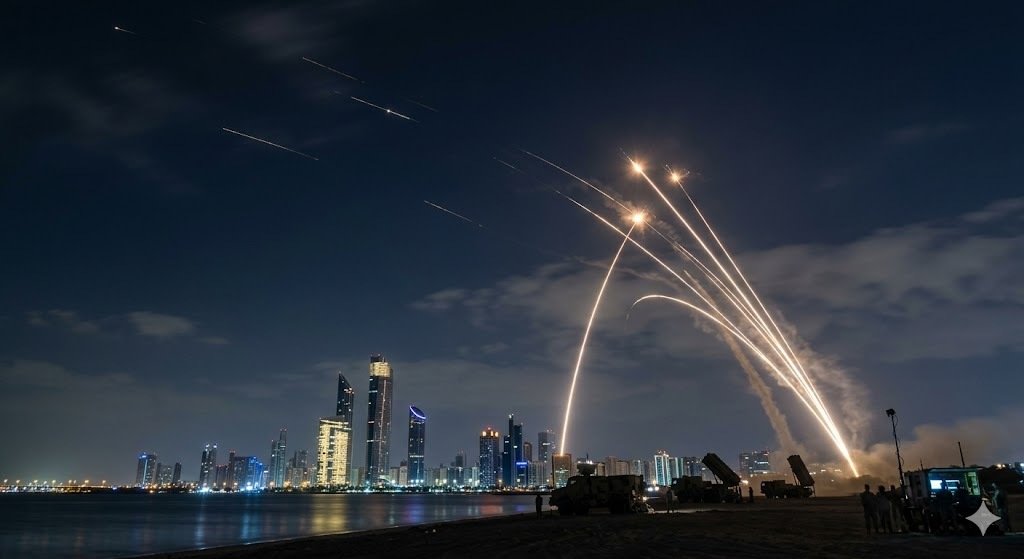
The UAE’s Ministry of Defence said its air defences “engaged” 12 ballistic missiles, three cruise missiles, and four drones launched from Iran over the course of the day. The country’s Ministry of Foreign Affairs condemned in the “strongest terms the renewed terrorist, unprovoked Iranian attacks, targeting civilian sites and facilities in the country.” It said it will not tolerate any threat to the UAE’s security and sovereignty, and warned that it reserves the “full and legitimate right to respond” to the attacks.
What Triggered the Attacks?
The renewed assault did not happen in a vacuum. It was ignited by a direct chain of events beginning with the launch of the US military’s “Project Freedom” the short-lived operation to escort stranded merchant ships through the Strait of Hormuz.
The attacks on the UAE began after Iranian media reported that the IRGC had prevented US warships from entering the Strait of Hormuz “with a firm and swift warning.” The attacks came after US President Donald Trump launched a new effort to escort stranded tankers out of the vital energy chokepoint of the Strait of Hormuz, which has been largely closed since the US-Israel war on Iran began on February 28.
The UAE accused Iran of targeting a tanker linked to its main oil company ADNOC the Barakah oil tanker with two drones as it navigated the strait. UAE presidential adviser Anwar Gargash condemned the attack on the Barakah as “maritime piracy“, while ADNOC said that no one was injured and the vessel was not loaded. The missile and drone salvoes followed.
The Attack in Detail Missiles, Drones, and a Burning Refinery
The UAE Ministry of Defence confirmed that four cruise missiles launched from Iran were detected toward various areas across the country. Three were successfully engaged over the country’s territorial waters, while one fell into the sea.
The most significant and visible blow was struck in the east of the country. The emirate of Fujairah said an Iranian drone sparked a “large fire” at the Fujairah Petroleum Industries Zone, and three Indian citizens were moderately injured during the attack.
The fire caused Abu Dhabi National Oil Company (ADNOC) to shut off its refinery a facility that would otherwise produce 922,000 barrels of oil per day. The Port of Fujairah is uniquely critical to global energy security because, unlike the ports of Dubai and Abu Dhabi which sit inside the Strait of Hormuz, Fujairah is located on the Gulf of Oman meaning it serves as the primary bypass route for oil exports when the strait itself is closed or contested.
The facility handles approximately 1.7 million barrels per day, representing roughly half of the UAE’s total export capacity. The drone strike triggered a major fire at the oil refinery complex, suspending oil-loading operations and sending shockwaves through global energy markets that had been hoping the spring 2026 ceasefire would mark the end of the regional conflict.
Military Targets Hit Including British and Australian Bases
The attacks were not limited to oil infrastructure. Al Minhad Air Base was also attacked with drones and missiles launched from Iran. The air base is operated by the United Arab Emirates Air Force and the Royal Air Force. It is also home to Camp Baird — the Australian Defence Force Headquarters Middle East. The strikes therefore constituted an attack on British and Australian military personnel, drawing sharp international reactions from London and Canberra.
A Shahed-type drone reportedly struck the Fairmont The Palm Hotel on Palm Jumeirah, causing a large explosion and fire. Four individuals were critically injured, primarily from debris and blast effects, with windows shattering in nearby buildings. A drone attack in the City Walk area of Dubai caused a fire and damage which was later contained.
The UAE said it intercepted a “new wave” of Iranian missiles, and debris from interceptions fell in Abu Dhabi and Dubai, causing damage and fire to the lower floor of the Burj Al Arab hotel.
The War’s Toll on UAE A Cumulative Crisis
Monday’s attack did not occur in isolation. It was the latest in a relentless campaign that has been running since the day the war began.
As of May 9, 2026, the UAE has intercepted and destroyed 549 ballistic missiles, 29 cruise missiles, and 2,260 drones fired from Iran using its THAAD and Patriot missile defence systems. The attacks have killed 13 people including two military personnel, one civilian contractor, and 10 other civilians and injured 227 others from multiple nationalities including Emirati, Egyptian, Indian, Pakistani, Filipino, Bangladeshi, Sri Lankan, and many others.
Earlier in the conflict, the Emirates Global Aluminium plant at Al Taweelah in Abu Dhabi was struck, causing severe damage leading to an operational shutdown. Repairs are expected to take up to one year. Employees were injured in the attack.
Analysts have raised a profound strategic concern. By late March 2026, analysts of the Jewish Institute for National Security of America estimated that Gulf states had burned through the majority of their interceptor missiles, with the UAE and Kuwait having spent some 75% of their stock of Patriot missiles defending against Iranian attacks, while Bahrain was estimated to have launched up to 87% of its supply.
Schools Across the UAE Go Remote Millions of Students Affected
Perhaps the most striking domestic consequence of the renewed attacks has been the nationwide shutdown of UAE schools.
The UAE’s Ministry of Education announced distance learning for all public and private schools nationwide, citing the need to ensure
The UAE’s emergency alert system was triggered five times within three and a half hours as Iranian missiles were detected.
The Ministry of Education confirmed that classrooms would transition fully online, adding: “The situation will be reviewed on Friday, May 8, 2026, and the period may be extended if necessary.”
The human dimension was vivid. School leaders mobilised late into the evening to realign timetables particularly for examination year groups as families across the UAE received emergency notifications. Zeina Abdalla, mother of three children aged seven, nine and eleven, told reporters: “I’d rather have them home where I know they’re safe. Schools have been very quick to get kids back on track and have done a great job making sure no one falls behind.”
Iran’s Denial and CENTCOM’s Rebuttal
Iran’s official position has been characteristically murky. There was no official comment from Iran. But state broadcaster IRIB quoted a well-informed military source as saying that Iran had “no pre-planned programme to attack the mentioned oil facilities,” attributing the incidents to “US military adventurism aimed at creating a passage for the illegal transit of ships through the restricted waterways of the Strait of Hormuz.”
US Central Command (CENTCOM) debunked Iranian state media reports claiming that an American warship had been struck with missiles, posting on X: “No US Navy ships have been struck. US forces are supporting Project Freedom and enforcing the naval blockade on Iranian ports.”
Meanwhile, the IRGC went further — declaring a new zone of authority in the waterway. The IRGC declared a new maritime “smart control” area in the Strait of Hormuz, with a zone spanning from Mount Mobarak in Iran to south of Fujairah in the UAE in the south, and from the end of Qeshm Island to Umm Al Quwain in the west. In effect, Iran was asserting sovereign-like control over some of the most strategically vital waters on the planet.
The Regional and Global Reaction
The attacks drew immediate and sweeping international condemnation.
The UAE’s Ministry of Foreign Affairs called the attacks a “flagrant violation of UNSC Resolution 2817,” demanding an immediate cessation of all hostilities. Saudi Arabia’s Crown Prince Mohammed bin Salman separately called for diplomatic progress and encouraged the US to pause Project Freedom to allow space for negotiations a call Trump responded to within hours.
Australia closed its embassy in Abu Dhabi and its consulate in Dubai. The UK confirmed it was monitoring the situation at Al Minhad Air Base, where Royal Air Force personnel are stationed. The G7 foreign ministers jointly condemned Iran’s attacks as “unjustifiable” and “reckless.” The European Council president stated that the EU was working with the UAE to restore stability and open the Strait of Hormuz.
On a regional level, the attacks exposed deep fractures. The 2026 Iran conflict exposed significant rifts within the expanded BRICS alliance, paralyzing its ability to form a cohesive response or issue a joint statement. The direct involvement of members Iran and the UAE on opposing sides prevented consensus, exposing the limits of the bloc’s political unity.
The Strategic Logic Why Iran Targeted Fujairah
The choice of Fujairah as a primary target was not random. It reflects Iran’s sophisticated understanding of global energy geography.
Iran is well aware that Fujairah is the world’s second-largest bunkering port and the primary exit route for Gulf oil that bypasses the Strait of Hormuz. By striking Fujairah alongside keeping the strait closed, Iran is attempting to close both the front door and the back door of Gulf energy exports simultaneously a strategy designed to maximise economic pain on the US, its Gulf allies, and the entire global economy.
Natasha Turak, a journalist based in Dubai, noted: “Both sides have now ratcheted up the escalation, and the UAE, suddenly, is the first to feel that blowback from the uptick in escalation, just as it was when the conflict began. This country has received the highest volume of Iranian attacks, and it seems like it’s all kicked off again.”
What Happens Today Friday, May 8
Today is the day the UAE Ministry of Education said it would review the school closure situation. The decision whether UAE schools reopen on Monday or remain on remote learning will be watched closely as a barometer of how seriously authorities view the continued security threat.
Analysts observed that the key drivers of the war and the main sticking points between the US and Iran have not yet been resolved, making further attacks on the UAE a persistent risk regardless of diplomatic progress.