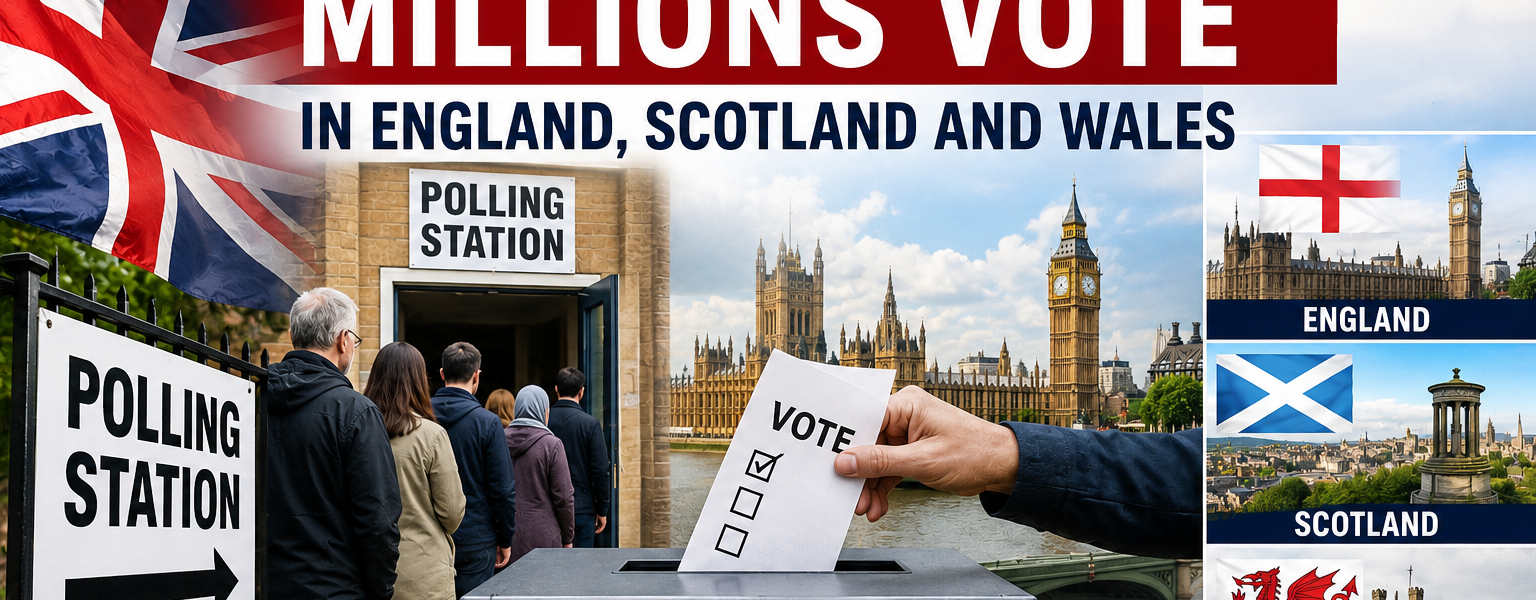
Today, millions of voters in Scotland and Wales head to the polls to vote for their new representatives in the Scottish Parliament and the Welsh Senedd. Simultaneously, elections are being held for councils, mayors, and other local bodies across England making this one of the most significant electoral days in the United Kingdom since the 2024 General Election.
The local and devolved elections on 7 May 2026 represent a major political test for Prime Minister Keir Starmer, the First Ministers of Scotland and Wales, and local leaders across England. Polling stations across all three nations close at 10 PM tonight, with results expected to flow through Friday and into Saturday.
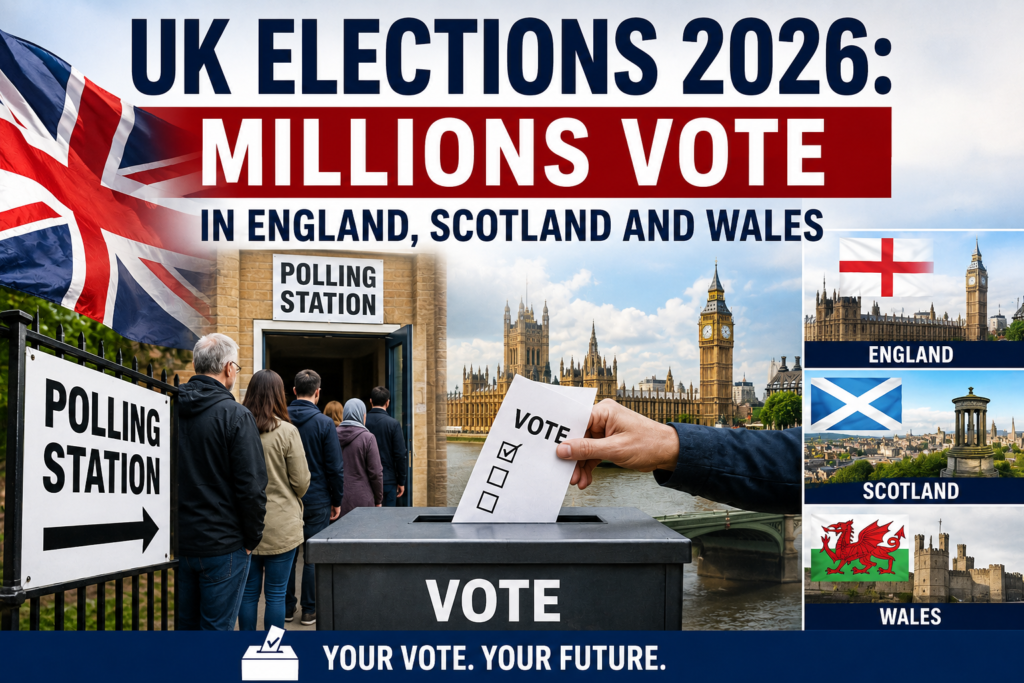
What Is Being Voted On?
England
More than 5,000 council seats are being contested across 136 local authorities in England, covering a wide range of council types including boroughs, counties, and districts. Over 25,000 candidates were nominated to stand, with Reform UK, Labour, the Conservatives, and the Green Party all fielding candidates in over 95% of wards.
Several high-profile mayoral contests are also on the ballot, including in Greater Manchester, the West Midlands, and London.
Scotland
The Scottish Parliament established in 1999 following devolution is made up of 129 MSPs: 73 constituency MSPs and 56 regional MSPs. Voters today choose who will govern Holyrood for the next parliamentary term, with the SNP seeking to hold its dominant position in Scottish politics.
Wales
The Senedd is changing significantly in 2026 it will now be made up of 96 Members, up from 60, elected from across Wales. In 2026, each constituency will elect six Members, with voters casting one vote for the political party or independent candidate of their choice. This is the most structurally significant Welsh election in a generation.
The Political Landscape: A System Under Pressure
The grip of the two main parties has ended. Last year’s local elections saw Labour and the Conservatives win the lowest share of council seats since at least the 1970s and that trend looks set to accelerate, with five parties now polling in double digits.
Reform UK, which saw just seven councillors elected in 2022, is now leading the polls. England-wide polling shows Labour which led in 2022 in third place, squeezed on all sides. These elections take place during a time of deep unpopularity for the governing Labour Party, amid scandals and with Reform UK and the Greens rising sharply in the opinion polls.
Reform UK: The Force to Watch
Nigel Farage’s party has mounted the most aggressive local election campaign in its short history. On 1 January 2026, Farage announced plans to spend more than £5 million over four months on a mass direct mail and social media campaign, calling this year’s local elections the “single most important event” before the next general election.
Reform is projected to take control of county councils in Essex, Norfolk, and Suffolk a potentially historic realignment in England’s rural heartlands. In Sunderland, both Labour and Liberal Democrat sources have described a Reform victory there as “likely.”
The Green Surge
These elections are the first national contest since Zack Polanski became leader of the Green Party and the party has risen sharply in popularity polls under his leadership.
The Greens are polling 12–14% nationally, and could take Hastings and challenge in Norwich, Sheffield, and inner London. A dramatic preview of the Green momentum came recently when Green candidate Hannah Spencer won the Gorton and Denton by-election, defeating Reform UK, with incumbent Labour falling to third place.
What Happens in Scotland and Wales?
Scotland: The SNP are in a better position than Labour in England and are likely to remain the largest party, though short of a majority. Reform is expected to gain representation, potentially becoming the largest unionist party at Holyrood.
Wales: Polling suggests a tight race between Plaid Cymru and Reform, with Welsh Labour a distant third. The new, more proportional Senedd electoral system makes a majority government unlikely, and most analysts expect coalition negotiations to follow. Two blocs are possible: a broadly left grouping of Plaid, Labour, the Greens, and the Lib Dems or a right-leaning alliance of Reform and the Welsh Conservatives.
Labour’s Difficult Night Ahead
Labour is defending seats won during the Partygate era of 2022, when it polled 35%. It now polls around 20%, and is projected to lose heavily concentrated in northern metropolitan boroughs where Reform is surging.Labour is defending more than 2,500 seats, and projections suggest Labour could lose control in Wigan, Sunderland, and Barnsley. The Unite union’s General Secretary Sharon Graham warned earlier this year that Labour would be “decimated” in the upcoming local elections.
The Conservatives: Squeezed from Both Sides
The Conservatives face Reform in Leave-voting areas and the Liberal Democrats in the south. Several councils held for decades are at risk. The Home Counties areas that returned Conservative and Liberal Democrat councillors in 2021 and 2022 but are now often represented by Liberal Democrat MPs may deliver a second and potentially more damaging blow to the party.
The scale of Conservative losses tonight could determine how long Kemi Badenoch survives as party leader.
When Will We Know the Results?
Results begin to come in from the night of Thursday, 7 May, soon after polling closes at 10 PM. Most results are announced throughout Friday, 8 May, while some councils especially larger ones may continue counting into Saturday, 9 May 2026.
Scottish Parliament and Senedd results are also expected throughout Friday.
Why These Elections Matter Beyond Local Government
The insurgencies taking shape across England, Scotland, and Wales take different forms Reform drawing on cost-of-living frustration and anti-immigration sentiment, the Greens capitalising on progressive disillusionment with Labour, and Plaid Cymru focusing on national identity. But all are being fed by a similar dissatisfaction with stagnant living standards and a growing sense that the existing political system has not delivered.
Tonight’s results will not just reshape town halls and devolved chambers. They will set the tone for British politics heading toward the next Westminster general election and send an unmistakable message about where millions of British voters now stand.