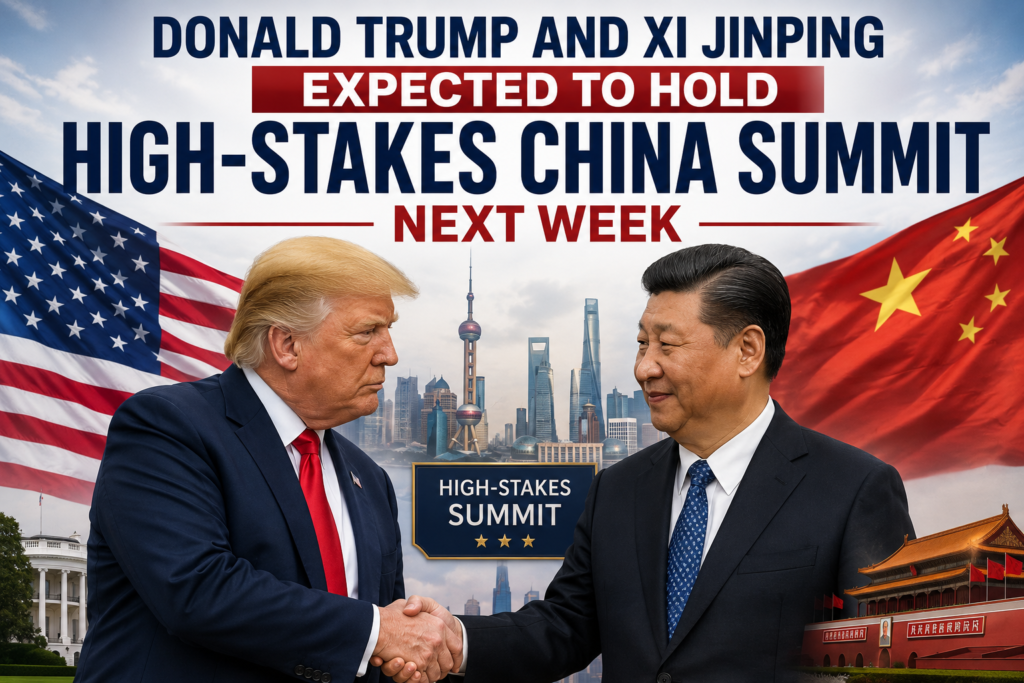
Donald Trump and Xi Jinping Expected to Hold High-Stakes China Summit Next Week
The long-delayed summit between US President Donald Trump and Chinese President Xi Jinping is now finalised for May 14–15, 2026, when Trump travels to Beijing. Trump’s visit to Beijing will be the first by a sitting US President to China since 2017, highlighting how rapidly evolving geopolitical crises are reshaping international diplomacy.
With the world already grappling with the economic fallout from the Middle East conflict and a fragile US-China trade truce on a ticking clock, the stakes for this summit could hardly be higher.
Why Was It Delayed?
The summit was originally scheduled for March 2026 but was delayed because the US became embroiled in its war against Iran by aligning with Israel, rattling world energy markets and placing the Strait of Hormuz at the centre of global attention.
The postponement did nothing to reduce the urgency f anything, it raised it. The Iranian conflict has since added an entirely new and complex dimension to the already strained US-China relationship.
Iran: The Elephant in the Room
Trump wants to seek Beijing’s cooperation to press Tehran to accept a ceasefire proposal. This gives China unusual diplomatic leverage, as China’s economic ties with Iran remain strong, positioning Beijing as a critical player in any broader diplomatic effort to stabilise global energy markets.
The Iran conflict’s energy dimension will hang prominently over the Trump-Xi summit. The disruption to energy markets has substantially increased the cost of Chinese energy imports, and Xi will be anxious to ensure these disruptions are minimised particularly if the conflict is still ongoing by the time the summit begins. Brookings
Trump has also been putting pressure on China and other nations to send warships to secure access to Middle Eastern oil, with NATO member states divided on the demand. Eurasia Review
Trade Truce and Its Expiry Date
When Trump and Xi met in Busan, South Korea in October 2025, they negotiated a one-year truce and agreed on guidelines aimed at stabilising what both sides described as mutually beneficial economic relations. But that window is closing fast. The Busan trade truce expires in November 2026, and with it, much of the political space that makes even limited cooperation possible. Both sides face enormous pressure to either extend the arrangement or replace it with something more durable. China watchers expect both leaders will likely announce Chinese purchases of American products, such as Boeing airplanes and agricultural goods, as well as a bilateral “Board of Trade” to identify non-sensitive sectors for purchase commitments and limited tariff adjustments.
China Plays Its Cards Before the Summit Even Begins
Beijing has made clear it is not entering this meeting from a position of weakness. On May 2, China’s Ministry of Commerce issued Announcement No. 21 a directive instructing every Chinese citizen, company, and organisation to neither recognise, enforce, nor comply with certain US sanctions. Fortune
The timing was deliberate an unmistakable prelude to the Beijing summit signalling that the rules of engagement are being rewritten, and they are being rewritten in Beijing. Analysts note that the implications extend beyond the bilateral relationship, as China leads the BRICS bloc, and others are expected to follow Beijing’s template.
What Analysts Are Watching
Spaces to watch will include any announcement of major Chinese investments into the United States and any potential shift in long-standing American declaratory policy on Taiwan. Brookings
On the broader relationship, outside observers are advised to keep expectations measured. While the relationship has stabilised since the two leaders last met, it remains fragile defined more by an absence of friction than any affirmative agenda or resolution of deep structural differences. Brookings
Presidential-level communication is currently the only real guardrail in US-China relations a critical channel to prevent miscalculation from escalating into conflict. Brookings
Domestic Pressure on Trump
Trump’s approval rating has plummeted to 36%, reflecting growing domestic concerns including rising gasoline prices linked to Middle East instability, inflationary pressures tied to global energy markets, and public scrutiny over foreign policy decisions. The Beijing summit is therefore as much a domestic political moment as it is a diplomatic one Trump needs a visible win.
Washington views the visit as a strategic opportunity to stabilise relations between the world’s two largest economies at a time of heightened uncertainty. Whether that opportunity is seized or squandered will be watched closely from every major capital in the world.
Looking Ahead
The President and First Lady Melania Trump also plan to host Xi and his wife Peng Liyuan for a White House visit later this year the two leaders have stated they may meet as many as a record four times in 2026. The frequency of contact itself is meaningful. In a bilateral relationship with so many fault lines trade, technology, Taiwan, Iran, and global financial stability keeping dialogue alive may be the most important outcome of all.
Bottom Line: The May 14–15 Beijing summit is arguably the most consequential diplomatic meeting of 2026. With an Iran ceasefire hanging in the balance, a trade truce approaching its expiry, and Beijing asserting itself on the global stage, both leaders arrive with a great deal to gain and even more to lose.